Research Article | | Peer-Reviewed

Optical Response and Light Propagation in Bimetallic Quantum Dot Ag@Au Core-shell Nanocomposite Embedded in Non-absorptive Host Medium

Received: 11 October 2025     Accepted: 21 October 2025     Published: 28 November 2025
Views:       Downloads:
Abstract

In this research work, optical and dispersion responses of bimetallic quantum dot Ag@Au core-shell nanostructures embedded in the non-absorptive host-medium, along with the propagation of slow and fast light waves through these structures, have been investigated. The local field enhancement factor, absorption coefficient, refractive index and group velocity were studied by engineering silver (Ag) as a core and gold (Au) as a shell. The study is based on the quasi-static approximation of classical electrodynamics for composite radii ranging from 6 to 10 nm. Within this quantum dot configuration, two sets of plasmonic resonances were observed in the visible spectral region, corresponding to the two interfaces of the core–shell geometry. The optical properties of the composite were found to depend on factors such as core size, shell thickness, overall composite size, filling factor, and the dielectric function of the host medium. The two plasmonic resonances become closer and more intense as the composite size decreases for a fixed core size, while they shift in opposite directions. Moreover, the resonance peak intensity decreases as the core size increases for a fixed composite size. For optimized core/composite dimensions, shell thickness, and other parameter values, these Ag@Au core–shell nanostructures are promising for diverse applications including photocatalysis, biomedicine, nano-optoelectronics, security technologies, and optical communication.

Published in American Journal of Optics and Photonics (Volume 13, Issue 1)
DOI 10.11648/j.ajop.20251301.12
Page(s) 17-26
Creative Commons

This is an Open Access article, distributed under the terms of the Creative Commons Attribution 4.0 International License (http://creativecommons.org/licenses/by/4.0/), which permits unrestricted use, distribution and reproduction in any medium or format, provided the original work is properly cited.

Copyright

Copyright © The Author(s), 2025. Published by Science Publishing Group

Keywords

Core-shell, Light Wave, Group Velocity Index, Bimetallic, Enhancement Factor, Dielectrics Function

1. Introduction
Core–shell nanoparticles (CSNPs) are one of the most important types of composite materials, consisting of more than one distinct constituent - one serving as the core and the other as the shell - formed through an encapsulation process with various geometries and sizes, depending on the desired application . The main objective of this process is to obtain new materials with combined and/or unique properties that are not observed in their individual counterparts . The core and/or shell materials of the composite can be metallic, semiconducting, dielectric, or organic/inorganic in nature . Among the various combinations of core–shell nanostructures, metal@metal core–shell nanocomposites exhibit novel properties suitable for a wide range of applications. These unique properties primarily arise from the interaction between metallic (plasmonic) materials and the electromagnetic field, which is enhanced by a phenomenon known as surface plasmon resonance (SPR), as well as from the coupling between the plasmons of the metallic shell and those of the core . At SPR frequencies, the collective oscillations of conducting electrons in the metallic nanoparticle are driven by incident resonant light, causing them to behave as electric radiating dipoles. In addition, metallic nanoscale materials possess strong absorption properties across the visible spectral region due to their relatively high absorption index .
Previously, the properties of two-layered bimetallic core–shell nanostructures (CSNSs) have been investigated both experimentally and theoretically for a variety of applications. These bimetallic core–shell nanostructures have attracted significant attention because of their unique physicochemical properties and potential uses in catalysis, electronics, optoelectronics, information storage, biosensing, optical sensing, optical switching, communication, and surface-enhanced Raman spectroscopy (SERS). Due to surface plasmon resonance (SPR) excitations, metallic core–shell nanoparticles at the quantum dot scale exhibit distinctive optical characteristics.
In the present study, the author reports the slow and fast electromagnetic light wave propagation and plasmonic response of a composite consisting of silver (Ag) as the core and gold (Au) as the shell in the quantum dot size range. Although the optical properties and applications of noble metal@metal nanocomposites have been explored previously , to the best of our knowledge, the local field enhancement factor, absorption coefficient, and electromagnetic wave propagation in Ag@Au core–shell nanocomposites at the quantum dot scale have not yet been reported.
Monometallic nanoparticles often exhibit limitations for certain applications; therefore, combining them with other noble metals can modify or generate new properties suitable for specific uses. Considering the exceptional physicochemical characteristics and versatile applications of noble metals, this work focuses on the optical and dispersion properties of Ag nanoparticles coated with Au. Both Ag and Au nanoparticles (NPs) have been extensively studied due to their high catalytic activity, excellent biocompatibility, strong optical sensitivity, facile synthesis, resistance to oxidation, and SPR bands capable of absorbing and scattering visible light more effectively than other noble metals . The plasmonic resonance of small bimetallic Ag–Au systems can be tuned from the visible to the near-infrared (NIR) spectral region . Owing to these noble properties and broad applicability, the Ag@Au core–shell configuration is considered a promising strategy to achieve new and enhanced functionalities for advanced applications.
The paper is organized as follows: Section 2 presents the theoretical description of the bimetallic quantum dot Ag@Au core–shell nanocomposite, developed using the electrostatic approximation. Section 3 discusses the numerical analysis and results, while Section 4 provides the concluding remarks.
2. Materials and Methods
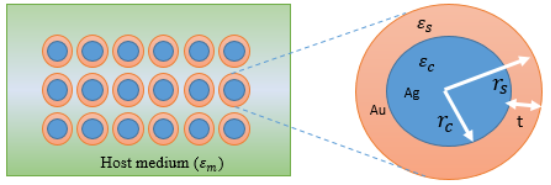
Consider a two-layered core-shell nanoparticle (CSNP) consisting of a metallic silver (Ag) core with a dielectric function (DF) of εc, and a metallic gold (Au) shell of dielectric function of εs embedded in a non-absorptive host matrix (magnesium fluoride = MgF2) characterized by a real DF εm. The radii of core and shell are denoted by rcrsρ=1-(rc/rs)3
Figure 1. (Color online) The array of Ag@Au CSNSs embedded in the non-absorptive dielectrics host medium (left side) and cross-sectional view of one nano-inclusion (right side).
When a metallic object is placed in a uniform external electric field, polarization occurs at its surface. In the far-field region, the polarized object can be approximated as an electric dipole, since the higher-order field components decay rapidly with increasing distance .
The induced electric dipole moment of the composite can be expressed as ,
p̃=εmαE0, (1)
where E0 is external applied electric field and α is the polarizability of the system (the nanocomposite and the host medium) given by,
α=4π1-32εmεc+εs(3ρ-1)βrs3.(2)
The variable β in Eq. (2) is,
β=εs2+Cεs+εcεm,(3)
where
C=32ρ-1εc+3ρ-1εm.(4)
The effective permittivity (εeff) of the composite given by ,
εeff=εm1+2фη1-фη,(5)
where, η is the dimensionless polarizability defined by
η=1-32εmεc+εs(3ρ-1)β,(6)
and, ф is the dimensionless filling factor express as,
ф=N4πrs33.(7)
N is the density number of the nano-inclusion in the host matrix.
For simplicity, as shown in Figure 1, we assume a Drude model for the metal, which is adequate for describing certain simple and noble metals within appropriate ranges of light frequencies. The Drude model provides an effective description of the free-carrier response in metals. Hence, the dielectric functions of silver (Ag) and gold (Au) can be expressed using the Drude model as :
εω=ε-ωp2ωω+iω0,(8)
where ε is the phenomenological parameter describing the contribution of bound electrons to the polarizability, ωp is the bulk plasmon frequency, ω0 is the damping constant of the bulk material, for Ag, ε=4.5, ω0=0.072 eV,ωp=9.02 eVε=9.84ω0=0.011 eVωp=9.62 eV
3. Results and Discussion
For composites with dimensions smaller than the wavelength of the incident light, the quasi-static approach is appropriate for calculating the polarizability. At the nanoscale, the incident electric field can be considered spatially uniform across the entire structure, allowing the composite to be approximated as an oscillating dipole. This simplification is referred to as the quasi-static approximation.
3.1. Local Field Enhancement Factor
The local electric field within the composite can be enhanced due to the differences in dielectric properties between Ag and Au, as well as between Au and the MgF2 host, in addition to the surface plasmon resonance of the Ag/Au interface. The field enhancement factor is defined as the ratio of the electric field intensity around the composite to the applied electric field intensity. The local field enhancement factor (LFEF), (η2) of the nano-composite is expressed as ,
 η2=E2E02=1+α2πrs2,(9)
where E is electric field inside the composite, E0 is an applied external electric field and rs is the radius of the composite.
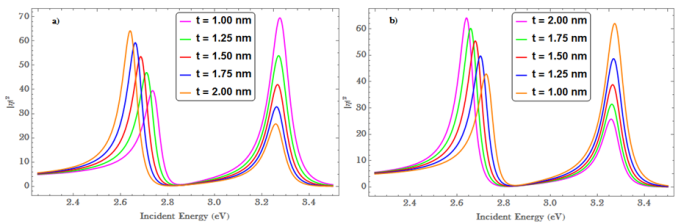
Using Eq. (9), the local field enhancement factor (LFEF) is illustrated in Figure 2 by optimizing the sizes of the core and the composite. As shown in the Figure, two plasmonic resonances are observed, corresponding to the outer (Au/MgF2) and inner (Ag@Au) interfaces of the plasmonic shell, from left to right . For a fixed composite size of 10 nm in Figure 2(a), when the core size is decreased (i.e., the shell thickness (t) is increased) with the corresponding volume fractions of 0.271, 0.330, 0.386, 0.438, and 0.488, the first resonance associated with the Ag@Au interface is enhanced and red-shifted, while the second resonance associated with the Au/MgF2 interface decreases in intensity without shifting. The plasmonic response of the composite also varies with the overall composite size. When the composite size is decreased for a fixed core size of 8 nm, as depicted in Figure 2(b), the first resonance decreases and shifts towards higher energy, whereas the second resonance is enhanced without shifting. For a fixed core size, as the composite size decreases, the shell thickness (t) simultaneously decreases, with the corresponding volume fractions being 0.488, 0.448, 0.403, 0.353, and 0.298. From these Figures, it is observed that the first resonance becomes more intense with increasing volume fraction (i.e., when the volume fraction increases, the core material concentration decreases), whereas the second resonance at higher energy decreases with increasing volume fraction. For lower core concentrations, the resonance associated with the core surface is reduced. This behavior is primarily due to stronger interaction of the electromagnetic wave with the polarized charges at the interface of the composite when the shell material (Au) is more dominant. All parameters of the composite are exemplified in Table 1.
Figure 2. (Color online) Local field enhancement factor of Ag@Au core-shell nanostructures, (a) a decreasing core size for a fixed composite size and (b) a decreasing composite size for a fixed core size.
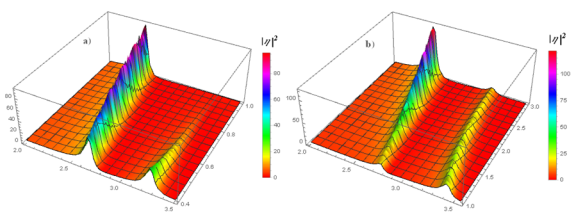
Among the different parameters that affect the optical and dispersion responses of a core–shell nanocomposite are the dielectric function of the host medium and the concentration of the shell material (ρ, the volume fraction of the shell relative to the composite) layered on the core. As depicted in Figure 3(a), when the concentration of the shell material increases (ρ1, the composite is pure Au) the first resonance becomes more intense, while the second resonance diminishes, as discussed above. This indicates that when the shell material dominates, only a single interaction occurs at the interface between Au and the host medium (Au@MgF2). However, for certain applications, multiple resonances in different spectral regions are desirable. Beyond ρ=0.7, the second resonance diminishes, indicating that the contribution of the core material becomes almost negligible. Another important parameter is the dielectric function (DF) of the host medium, which strongly influences the plasmonic properties of the core–shell nanostructure. As shown in Figure 3(b), various dielectric materials with DF values between 1.0 and 3.0, including air and water, are considered. In this analysis, the size of the nanocomposite is fixed at rc=8 nm and rs=10 nm. As shown in this Figure, the first resonance is more enhanced and red-shifted but the second resonance is slightly decreased. The Figure shows that the first resonance is enhanced and red-shifted, while the second resonance is slightly reduced. The first resonance, associated with the shell–host medium interface, becomes more pronounced as the dielectric function εm of the host medium increases from 1 to 3.
Figure 3. (Color online) Local filed enhancement factor of Ag@Au core-shell nanostructures, (a) as a function of shell material concentration for a fixed εm value and (b) as a function of DF of host medium for t=2.00 nm.
From the results, it is evident that the applied electromagnetic field is enhanced and shifted toward the infrared spectral region for host media with high dielectric functions. Nanocomposites exhibiting enhanced electric fields in the near-infrared spectral region may be suitable for a variety of applications.
3.2. Absorption Coefficient
By considering the quasi-static limit approximation method, the absorption (σabc), scattering (σscc) and extinction coefficient (σexc) can be modeled as the plasmonic response and have the following relation,
σabc=kπrs2Im[α],(10)
σscc=k26π2rs2α2,(11)
σexc=σabc+σscc,(12)
where k=2πεm/λ .
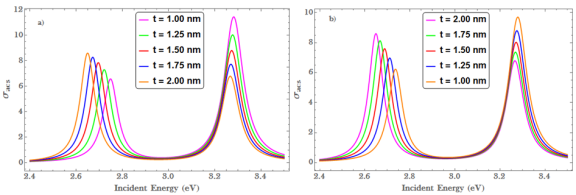
In general, incident light propagating through the nanocomposite is attenuated by both absorption and scattering . The absorption and scattering coefficients of the nanocomposite depend on its size and other parameters; for small composites, the absorption coefficient is typically larger than the scattering coefficient . Since the diameter of the Ag@Au core–shell nanostructure (20 nm) is smaller than the wavelength of the incident light, the absorption coefficient dominates over the scattering coefficient. For quantum-sized core–shell nanoparticles, the extinction coefficient is nearly equal to the absorption coefficient. Therefore, in this study, we primarily focus on analyzing the absorption coefficient of the nanocomposite.
In simple terms, the plasmonic properties of a core–shell nanostructure vary with the shell thickness and the sizes of the core and composite. Considering these parameters, this paper focuses on the plasmonic response of the novel composite material by simultaneously optimizing the core and composite sizes along with the shell thickness.
The absorption coefficient of Ag@Au core–shell nanostructures is shown in Figure 4. As illustrated, it varies with the sizes of the core and composite. Figure 4(a) shows that, for a fixed composite size of 10 nm, decreasing the core size enhances the first plasmonic resonance and shifts its peak to lower energy (red-shifted), while the second resonance decreases in intensity without shifting. In contrast, when the composite size is decreased for a fixed core size of 8 nm, the first plasmonic resonance in the visible spectral region decreases in intensity and shifts toward higher energy (see Figure 4(b)). The volume fractions corresponding to the shell thickness in Figure 4(a) and 4(b) are the same as those used in Figure 2(a) and 2(b), respectively.
Figure 4. (Color online) Extinction coefficient of Ag@Au core-shell nanostructures, (a) a decreasing core size for a fixed composite size 20 nm and (b) a decreasing composite size for a fixed core size 8 nm.
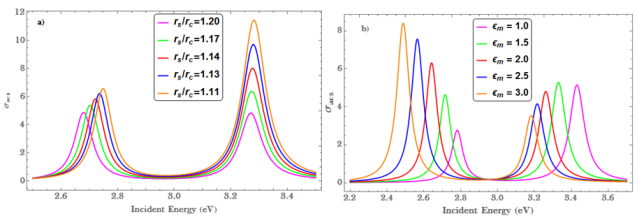
In another analysis, the absorption coefficient of the bimetallic core–shell nanocomposite was plotted by varying the radius of the system for a fixed shell thickness of 1.0 nm. As shown in Figure 5(a), when the dimensions of the Ag@Au core–shell nanocomposites are increased from 6 nm to 10 nm, the first absorption resonance slightly increases in intensity and shifts toward higher incident photon energy. In contrast, the second resonance is enhanced without shifting. As discussed in the previous section, the nature of the host medium strongly affects the plasmonic properties of the bimetallic core–shell nanostructure and, consequently, its absorption coefficient. Changing the dielectric function (DF) of the host medium modifies the plasmonic behavior and, correspondingly, the potential applications. As illustrated in Figure 5(b), the peak positions of both absorption resonances are red-shifted as the dielectric function of the host medium increases from 1 to 3 in steps of 0.5. Similar to Figure 3(b), the resonances associated with the outer interface of Au are more enhanced and exhibit a larger shift than those associated with the inner interface.
Figure 5. (Color online) Absorption coefficient of Ag@Au core-shell nanostructures for a fixed shell thickness t=1.0 nm (a) and the effect of dielectric function of the host-medium on the plasmonic response for a shell thickness t=2.0 nm (b).
3.3. Refractive Index
The plasmonic properties of a given nanocomposite material arise from the transmission, reflection, and absorption of incident light. In many plasmonic materials, the complex refractive index is one of the most important parameters. The refractive index is related to the dielectric function of the material, which describes the plasmonic interaction with the incident electromagnetic wave. The plasmonic response of a nonmagnetic nanocomposite structure to an incident electromagnetic wave can be represented by a complex refractive index (ñ).
ñ=n+ik=εeff,(13)
where εeff=ε,eff+iε,,eff is the complex effective dielectric function of core-shell nanocomposite medium.
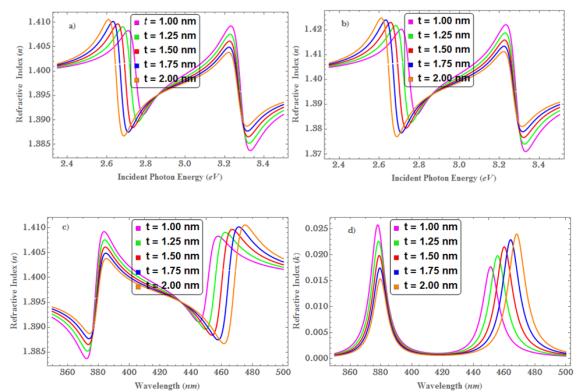
The following Figures are plotted for a composite radius of 10 nm and a filling factor (ϕ) of 0.001. The other relevant parameters are listed in Table 1.
Using Eq. (13), Figure 6 depicts the real (n) and imaginary (k) parts of the refractive index of the composite in a passive host matrix. Figures 6(a)-6(c) illustrate the real part of the refractive index as a function of incident photon energy and wavelength. In these Figures, at higher wavelengths (or lower incident photon energies), the plasmonic resonance is red-shifted as the shell thickness increases. To examine the effect of the filling factor (ф), Figure 6(b) shows the results when the filling factor is doubled (ф=0.002). In this case, the refractive index of the composite is further enhanced. As discussed above, the two resonances correspond to the interfaces of the shell material (Ag) . If one material (core or shell) dominates the other, the resonance associated with the interface of the less concentrated material becomes weak and may even diminish.
The imaginary part of the refractive index of the composite, shown in Figure 6(d), exhibits two plasmonic resonances corresponding to anomalous dispersion at the interfaces. As the volume fraction of the composite increases, the first resonance at lower wavelengths decreases in intensity without shifting, while the second resonance at higher wavelengths is enhanced and red-shifted. Due to electron transfer within this composite, emission in the visible spectrum is reduced, whereas emission in the ultraviolet (UV) region is enhanced, offering high tunability.
Figure 6. (Color online) Real part of refractive index (a-c) and imaginary part refractive index (d).
3.4. Light Wave Propagation
If an electromagnetic wave propagates through the nanocomposite with a refractive index n, the phase velocity can be expressed as v=c/n, where c is the speed of light in vacuum. Furthermore, the group refractive index ng of a linear-dispersive core–shell nanocomposite is related to the group velocity ng ,
vg=cng,(14)
The above equation describes the propagation of slow light through the nanocomposite. Using the definition of group velocity, the group refractive index] can be expressed in terms of the plasmonic frequency as
ng=n+ωdn,(15)
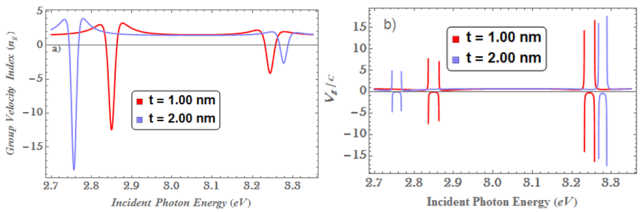
The group velocity of the composite can be controlled by optimizing the dispersion properties (dn/), which determine the propagation of light waves in the material. A large value of dn/ allows the realization of slow and fast light. Specifically, for a large and positive dn/, the group refractive index ng becomes very large, corresponding to a very small group velocity (c>vg>0), thus achieving slow light. Conversely, when dn/ is large and negative, the group velocity becomes negative, resulting in fast light propagation. Moreover, if ng0, the group velocity can be negative and approach ±. A negative group velocity indicates that the peak of the pulse exits the composite before the peak of the incident light enters, demonstrating superluminal (fast) behavior . In Figure 7(a), ng=0 is observed at four incident photon energies. The graph shows two minima, particularly for a shell thickness of 1 nm, with values of −12.59 and −4.21. As the shell thickness increases, these two resonances move further apart. Figure 7(b) shows five regions of vg/c, where three regions correspond to positive group velocity (vg/c>0) and the remaining two correspond to negative group velocity (vg/c<0). These regions are separated by two pairs of asymptotes at ng=0. The group velocity approaches, vg +, when the incident photon energy approaches a pair of asymptotes from outside, and vg -when approaching from inside the region. For t=1 nm, the maxima of vg/c are −0.391 and −0.565 between the first (left) and second (right) pairs of asymptotes, respectively. In general, as shown in the Figures, a large negative group velocity index results in a small negative vg/c, while the reverse is true for the second resonance at higher photon energy. These results are consistent with the expressions given in Eqs. (14) and (15).
Table 1. List of important parameters.

rc (nm)

rs (nm)

t (nm)

Core volume (nm3)

Composite volume (nm3)

ρ

Figure

9.00

10.00

1.00

729

1000

0.271

2a, 4a, 5a, 6a, 6b, 6c, 6d, 7a, 7b

8.00

10.00

2.00

512

1000

0.488

2b, 4b, 5b

8.75

10.00

1.25

670

1000

0.330

2a, 4a, 6a, 6b, 6c, 6d

8.00

9.75

1.75

512

927

0.448

2b, 4b, 5b

8.50

10.00

1.50

614

1000

0.386

2a, 4a, 6a, 6b, 6c, 6d

8.00

9.50

1.50

512

857

0.403

2b, 4b, 5b

8.25

10.00

1.75

562

1000

0.438

2a, 4a, 6a, 6b, 6c, 6d

8.00

9.25

1.25

512

792

0.353

2b, 4b, 5b

8.00

10.00

2.00

512

1000

0.488,

2a, 4a, 6a, 6b, 6c, 6d, 7a, 7b

8.00

9.00

1.00

512

729

0.298

2b, 4b, 5a, 5b

7.00

8.00

1.00

343

512

0.330

5a

6.00

7.00

1.00

216

343

0.370

5a

5.00

6.00

1.00

125

216

0.421

5a

Figure 7. (Color online) The group velocity index ng (a) and group velocity vg/c (b) versus incident photon energy (eV).

4. Conclusion
In this paper, we investigated the local field enhancement factor (LFEF), absorption coefficient, refractive index, group refractive index, and group velocity of Ag@Au core–shell nanostructures embedded in a non-absorptive host medium using the electrostatic approximation. All of these properties, as functions of incident photon energy and wavelength, exhibit two plasmonic resonances corresponding to the inner and outer interfaces of the metallic Au shell. For the LFEF and absorption coefficient, the first plasmonic resonance is enhanced and shifts to higher energy when the core size decreases for a fixed composite size, but decreases and shifts in the opposite direction when the composite size is reduced for a fixed core size. The second plasmonic resonance decreases with decreasing core size but is enhanced when the composite size decreases. Furthermore, increasing the volume fraction decreases the first resonance while enhancing the second for both LFEF and absorption coefficient. As the dielectric function of the host medium increases, the first plasmonic resonance of both the LFEF and absorption coefficient shifts toward longer wavelengths and becomes stronger, whereas the second resonance also shifts to longer wavelengths but weakens in intensity. Similarly, the first resonance of the real and imaginary parts of the refractive index is enhanced and red-shifted with increasing shell thickness (or volume fraction), while the second resonance is reduced. Slow and fast light propagation in the passive composite was analyzed using the group refractive index and group velocity. The results indicate that by optimizing the parameters of the core–shell nanocomposite, the conditions for superluminal and negative group velocity light can be controlled. Overall, these findings demonstrate that two-layered bimetallic core–shell nanocomposites, composed of a silver core coated with a thick gold shell, are promising candidates for applications in biomedicine, solar cells, catalysis, optical sensing, and information storage.
Abbreviations

Ag

Silver

Au

Gold

CSNP

Core-Shell Nanoparticle

DF

Dielectric Function

Eg

Photon Energy

LFEF

Local Field Enhancement Factor

MgF2

Magnesium Di Fluoride

NP

Nanoparticle

SERS

Surface-Enhanced Plasmon Resonance

SPR

Surface Plasmon Resonance

UV

Ultraviolet

Acknowledgments
This work is supported financially by the Adama Science and Technology University (ASTU).
Author Contributions
Gashaw Beyene Kassahun is the sole author. The author read and approved the final manuscript.
Conflicts of Interest
There is no conflict of interest.
References
[1] S. He, Z. Tang, T. Huo, D. Wu, J. Tang, Ag/Au Bimetallic Core–Shell Nanostructures: A Review of Synthesis and Applications. J. Manuf. Mater. Process. 2025, 9(4) 131.
[2] Getachew, E. Tadese 2025. Geometric Influence on Optical Bistability and Local Field Enhancement in Core-Shell Nanocomposites. Nanoscience and Nanometrology, 9(1), 11-19.
[3] Bartosewicz B, Michalska-Domanska M, Liszewska M, Zasada D., Jankiewicz B. J., 2017, Synthesis and characterization of noble metal-titania core-shell nanostructures with tunable shell thickness. Beilstein J. Nanotechnol. 2017, 8, 2083-2093.
[4] Beyene B, Senbeta T, Mesfin B, Q. Zhang, Plasmonic properties of spheroidal spindle and disc shaped core-shell nanostructures embedded in passive host-matrices. Optical and quantum electronics, 2020 52, 157.
[5] Lavorato G. C, Lima Jr E. Troiani H. E, Zysler R. D. Winkler, Exchange-coupling in thermal annealed bimagnetic core/shell nanoparticles. J. Allloys and Comp. 2015, 633, 333-337,
[6] Beyene G, Enhancing Optical Properties of Triple Layered Core-Shell Nanostructures. J. Chem. Sci. Eng. 2019, 2(2), 90-93.
[7] Kassahun G. B, High Tunability of Size Dependent Optical Properties of ZnO@M@Au (M = SiO2, TiO2, In2O3) Core/Spacer/Shell Nanostructure. Adv. Nano Res. 2019 2(1), 1-13.
[8] N. Senthilkumar, M. Ganapathy, A. Arulraj, M. Meena, M. Vimalan, I. Vetha Potheher, Two-step synthesis of ZnO/Ag and ZnO/Au core/shell nanocomposites: Structural, optical and electrical property analysis. J. Alloys Compd. 3018, 750, 171-181.
[9] E. R. Encina, M. A. Prez, E. A. Coronado, Synthesis of Ag@ZnO core-shell hybrid nanostructures: An optical approach to reveal the growth mechanism. J. Nanoparticle Res. 2013, 15, 1688.
[10] H. F. Zhang, Z. G. Liu, W. Shen, S. Gurunathan, Silver nanoparticles, synthesis, characterization, properties, applications, and therapeutic approaches. Int. J. Mol. Sci. 2016, 17(9), 1534.
[11] W. Brett, Boote, Hongsik Byun, Jun-Hyun Kim, One-pot synthesis of various Ag/Au bimetallic nanoparticles with tunable absorption properties at room temperature. Gold Bull, 2013, 46, 185-193.
[12] H. Jun Yin, et al., 2015 Ag@Au core-shell dendrites: a stable, reusable and sensitive surface enhanced Raman scattering substrate. Sci. Rep. 2015, 5, 14052.
[13] Srnova-Vloufova., et al., Core-Shell (Ag) Au Bimetallic Nanoparticles: Analysis of Transmission Electron Microscopy Images. Langmuir. 2000, 16, 9928-9935.
[14] Tayebeh Naseri, Fatemeh Pour-Khavari, Bimetallic Core-Shell with Graphene Coating Nanoparticles: Enhanced Optical Properties and Slow Light Propagation. Plasmonic. 2020, 15, 907-914.
[15] D. Chahinez, T. Reji, R. Andreas, Modeling of the surface plasmon resonance tunability of silver/gold core-shell nanostructures. RSC. Adv. 2018, 8, 19616-19626.
[16] C. Manhuan, Z. Mingshan, D. Yukou, Y. Ping, Enhanced photocatalytic hydrogen evolution based on efficient electron transfer in triphenylamine-based dye functionalized Au@Pt bimetallic core/shell nanocomposite. Int. J. Hydog. Energy. 2013 38(21), 8631-8638.
[17] Z. Yingzhen, S. Yingying, Z. Jingchuang, L. Shunxing, L. Yancai L. Ultrahigh electrocatalytic activity and durability of bimetallic Au@Ni core-shell nanoparticles supported on rGO for methanol oxidation reaction in alkaline electrolyte. J. Alloys and compd. 2020, 822(5), 153322.
[18] L. Chao, Y. Youzhi, Synthesis of bimetallic core-shell silver-copper nanoparticles decorated on reduced graphene oxide with enhanced electrocatalytic performance. Chem. Phys. Lett. 2020, 761(16), 137726.
[19] M. Zhou, K. Diao, J. Zhang, W. Wu, Controllable synthesis of plasmonic ZnO/Au core/shell nanocable arrays on ITO glass. Nanostructures. 2014, 56, 59-63.
[20] N. Daneshfar, K. Bazyari, Optical and spectral tunability of multilayer spherical and cylindrical nanoshells. Appl. Phys. A Mater. Sci. Process. 2014, 116, 611-620.
[21] Alexander Mumller, et al., Morphology, Optical Properties and Photocatalytic Activity of Photo- and Plasma Deposited Au and Au/Ag Core/Shell Nanoparticles on Titania Layers. Nanomaterials. 2018, 8(7), 502.
[22] H. Kettunen, H. Walln, A. Sihvola, Electrostatic resonances of a negative permittivity hemisphere. J. Appl. Phys. 2008, 103, 1-8.
[23] G. Beyene, T. Senbeta, B. Mesfin, Size dependent optical properties of ZnO@Ag core/shell nanostructures. Chinese J. Phys. 2019, 58, 235-243.
[24] S. Karimi, A. Moshaii, S. Abbasian, M. Nikkhah, Surface Plasmon Resonance in Small Gold Nanoparticles: Introducinga Size-Dependent Plasma Frequency for Nanoparticlesin Quantum Regime. Plasmonics, 2019, 14(4), 851-860.
[25] A. Derkachova, K. Kolwas, I. Demchenko, Dielectric function for gold in plasmonics applications: size dependence of plasmon resonance frequencies and damping rates for nanospheres. Plasmonics. 2016, 11(3), 941-951.
[26] M. Piralaee, A. Asgari, V. Siahpoush, Plasmonic properties of spheroid silicon silver nanoshells in prolate and oblate forms. Optik. 2018, 172, 1064-1068.
[27] A. R. Bijanzadeh, A study of the surface plasmon absorption band for nanoparticles. Int. J. Phys. Sci. 2012, 7(12), 1943-1948.
[28] J. J. Penninkhof, A. Moroz, A. van Blaaderen, and A. Polman, Optical Properties of Spherical and Oblate Spheroidal Gold Shell Colloids. J. Physicsl Chem. C. 2008, 112, 4146-4150.
[29] U. Bortolozzo S. Residori, J.-P. Pierre Huignard, Slow and fast light through wave-mixing processes. Laser Photonics Rev. 2010, 4(4), 483–498.
Cite This Article
  • APA Style

    Kassahun, G. B. (2025). Optical Response and Light Propagation in Bimetallic Quantum Dot Ag@Au Core-shell Nanocomposite Embedded in Non-absorptive Host Medium. American Journal of Optics and Photonics, 13(1), 17-26. https://doi.org/10.11648/j.ajop.20251301.12

    Copy | Download

    ACS Style

    Kassahun, G. B. Optical Response and Light Propagation in Bimetallic Quantum Dot Ag@Au Core-shell Nanocomposite Embedded in Non-absorptive Host Medium. Am. J. Opt. Photonics 2025, 13(1), 17-26. doi: 10.11648/j.ajop.20251301.12

    Copy | Download

    AMA Style

    Kassahun GB. Optical Response and Light Propagation in Bimetallic Quantum Dot Ag@Au Core-shell Nanocomposite Embedded in Non-absorptive Host Medium. Am J Opt Photonics. 2025;13(1):17-26. doi: 10.11648/j.ajop.20251301.12

    Copy | Download

  • @article{10.11648/j.ajop.20251301.12,
      author = {Gashaw Beyene Kassahun},
      title = {Optical Response and Light Propagation in Bimetallic Quantum Dot Ag@Au Core-shell Nanocomposite Embedded in Non-absorptive Host Medium},
      journal = {American Journal of Optics and Photonics},
      volume = {13},
      number = {1},
      pages = {17-26},
      doi = {10.11648/j.ajop.20251301.12},
      url = {https://doi.org/10.11648/j.ajop.20251301.12},
      eprint = {https://article.sciencepublishinggroup.com/pdf/10.11648.j.ajop.20251301.12},
      abstract = {In this research work, optical and dispersion responses of bimetallic quantum dot Ag@Au core-shell nanostructures embedded in the non-absorptive host-medium, along with the propagation of slow and fast light waves through these structures, have been investigated. The local field enhancement factor, absorption coefficient, refractive index and group velocity were studied by engineering silver (Ag) as a core and gold (Au) as a shell. The study is based on the quasi-static approximation of classical electrodynamics for composite radii ranging from 6 to 10 nm. Within this quantum dot configuration, two sets of plasmonic resonances were observed in the visible spectral region, corresponding to the two interfaces of the core–shell geometry. The optical properties of the composite were found to depend on factors such as core size, shell thickness, overall composite size, filling factor, and the dielectric function of the host medium. The two plasmonic resonances become closer and more intense as the composite size decreases for a fixed core size, while they shift in opposite directions. Moreover, the resonance peak intensity decreases as the core size increases for a fixed composite size. For optimized core/composite dimensions, shell thickness, and other parameter values, these Ag@Au core–shell nanostructures are promising for diverse applications including photocatalysis, biomedicine, nano-optoelectronics, security technologies, and optical communication.},
     year = {2025}
    }
    

    Copy | Download

  • TY  - JOUR
    T1  - Optical Response and Light Propagation in Bimetallic Quantum Dot Ag@Au Core-shell Nanocomposite Embedded in Non-absorptive Host Medium
    AU  - Gashaw Beyene Kassahun
    Y1  - 2025/11/28
    PY  - 2025
    N1  - https://doi.org/10.11648/j.ajop.20251301.12
    DO  - 10.11648/j.ajop.20251301.12
    T2  - American Journal of Optics and Photonics
    JF  - American Journal of Optics and Photonics
    JO  - American Journal of Optics and Photonics
    SP  - 17
    EP  - 26
    PB  - Science Publishing Group
    SN  - 2330-8494
    UR  - https://doi.org/10.11648/j.ajop.20251301.12
    AB  - In this research work, optical and dispersion responses of bimetallic quantum dot Ag@Au core-shell nanostructures embedded in the non-absorptive host-medium, along with the propagation of slow and fast light waves through these structures, have been investigated. The local field enhancement factor, absorption coefficient, refractive index and group velocity were studied by engineering silver (Ag) as a core and gold (Au) as a shell. The study is based on the quasi-static approximation of classical electrodynamics for composite radii ranging from 6 to 10 nm. Within this quantum dot configuration, two sets of plasmonic resonances were observed in the visible spectral region, corresponding to the two interfaces of the core–shell geometry. The optical properties of the composite were found to depend on factors such as core size, shell thickness, overall composite size, filling factor, and the dielectric function of the host medium. The two plasmonic resonances become closer and more intense as the composite size decreases for a fixed core size, while they shift in opposite directions. Moreover, the resonance peak intensity decreases as the core size increases for a fixed composite size. For optimized core/composite dimensions, shell thickness, and other parameter values, these Ag@Au core–shell nanostructures are promising for diverse applications including photocatalysis, biomedicine, nano-optoelectronics, security technologies, and optical communication.
    VL  - 13
    IS  - 1
    ER  - 

    Copy | Download

Author Information